

For background, see Part 1: “Reformation” Debate (vs. Lutheran Nathan Rinne) . . . Including St. Augustine’s Opposition to Imputed Justification, “Faith Alone” & Other Protestant Unprecedented Innovations
***
No traditional Catholic dogmas have been changed or overturned. We’re still against abortion and divorce and contraception (all Protestants agreed with us till 1930, and Luther thought it was murder). We still teach the Holy Trinity and everything in the Nicene Creed. If you think we have changed something, by all means provide the proof. But those who make these claims virtually never even try to do that.
First of all, I understand Dave’s frustration with me here. Regarding liberalism, we can certainly point out how we are all, not just Rome, tremendously affected! The Pew data shows this. Sadly, regarding all the important questions Pew asks about faith and morals, the Roman Catholics generally are closer to the Mainline denominations than the Evangelical and “Bible-believing” ones.
Yes; I just saw some polling yesterday about belief in the propriety of homosexual sex. The numbers were atrocious. Evangelical Protestants made the best showing (some 69% opposed, as I recall). About the same percentage of Catholics were in favor. But what people believe “on the ground” has nothing whatsoever to do with which body is correct in theology and moral teaching, or to what degree they are correct. All we can do in making comparisons — in the end — is look at a given group’s confessions and creeds and doctrinal statements. There are always ignorant and nominal people in every group. That’s a boring discussion. The poll I saw tells us that even 31% of evangelical Protestants (my old allegiance that I was proud to be a part of and still remember with great fondness) think that homosexual sex is perfectly fine.
That’s outrageous. I would say it immediately casts doubt that a person with such opinions is evangelical at all, since he or she clearly rejects biblical inspiration and inerrancy, and a Catholic saying that also rejects the Bible and unbroken Catholic moral teaching and thus has no business identifying as a “Catholic” in any meaningful, historically or even sociologically based sense of the title. It’s a disgrace. In other words, it’s a case of mistaken category identification or “dishonest advertising” (to call oneself an evangelical or a Catholic with such outlandish views). But that’s — as Nathan noted — what we all deal with today: rampant, relentless secularization and our beloved, oh-so-superior and holier-than-thou theological liberals, alongside the usual enemies of the world, the flesh, and the devil.
One thing the 19th century LCMS Lutherans were good at doing was convicting people that what they confessed or had on paper was essentially worthless if it was not practiced. Perhaps we should consider that that might apply here?
Of course all self-proclaimed Christians need to practice what they preach and be consistent and orthodox and moral, loving, etc. as traditionally understood. But that’s a different question from deciding yay or nay on which group to join. If the criterion had been the wonderful knowledge and Christian moral consistency of individual Catholics back in 1990 when I converted, I never would have become Catholic in a billion years. The evangelicals “won” that contest hands-down. But that was irrelevant. All that mattered to me was “which group is more biblical and which carried on the glorious legacy of apostolic and patristic teachings and practice?” The answer was extremely easy. One simply has to know in the first place which questions to ask and what to look for; how to properly make such a decision.
Going along with this, the following quote would probably be acceptable to most every person that we think is decent and who we would want to have as a neighbor:
There is no doubt that an element of the truly righteous life, or good life, is that it is characterized by real love and compassion which does not think about rewards, spontaneously comes from the heart, and shares the love of God with all people (see, e.g., Deut. 11).
Amen! May that tribe of people multiply like wildfire!
I know Rome certainly remains “dogmatic” today, but, to say the least, it is not very “dogmatic” to imply atheists can be saved, . . .
St. Paul did that in Romans 2, and St. Thomas Aquinas — in his ever-helpful distinctions — allowed for a possibility of it (which doesn’t have to be a great possibility). If someone doesn’t know something, they don’t. They can know God exists (as Romans 1 makes clear). But whoever is saved is saved by God’s grace, the sacrifice of Jesus on the cross, and through the Church (as Luther and Calvin also firmly held), whether they are aware of it or not. God knows how much everyone knows, and hence, how culpable they are; we don’t. I’m glad to let God be God, and we know He is extremely merciful and is love itself, as well as being the Great Judge.
We’ll know when we get to heaven what is the truth regarding all of these disputed matters and we’ll know the reasons why whatever is true, is true. Nathan can come look me up at that time and we’ll review our debates and see who got what right. It’ll be fun! We can all laugh about our past errors then, and see how silly and ungrounded they were, and how blind we all have been in cases where we were wrong, when we are perfected in knowledge and glorified. I can’t wait!
Google Gemini tells me that “The Council of Florence is viewed by the Roman Catholic Church as a valid, infallible ecumenical council that successfully defined key doctrines—such as the Filioque, purgatory, and papal supremacy….”, and that is sometimes considered the 21st Ecumenical Council.
That Council said this in its 11th session (1442):
It firmly believes, professes and preaches that all those who are outside the catholic church, not only pagans but also Jews or heretics and schismatics, cannot share in eternal life and will go into the everlasting fire which was prepared for the devil and his angels, unless they are joined to the catholic church before the end of their lives.
I dealt with this sort of thing at great length in reply to Reformed Baptist Gavin Ortlund (who has ignored some 40 of my replies to him, save one):
See also my many treatments of this topic, and some I have collected from others:
Is There Salvation Outside the Church? (Fr. William G. Most) [Catholic Culture, 1988]
No Salvation Outside the Church: Reply to Pastor Bill Keller [4-23-08]
Salvation Outside the Church [Joe Heschmeyer, Shameless Popery, 8-12-10]
Various Thoughts on Salvation “Outside” the Church [2012]
Ecumenism vs. No Salvation Outside of the Church? (vs. Dustin Buck Lattimore) [8-9-17]
Has Rome really resisted liberalism?
In our official teachings, yes: across the board, as no other Christian body has done. This is why I am a Catholic. Protestants institutionalize theological error and sin. We do not. That’s the essential difference in this discussion of how “liberal” different Christian communions are.
Is there any other church that so eagerly and vigorously embraced evolutionary theory – which certainly undermines the underlying account of creation, fall, and redemption in the scriptures – as much as did Rome?
It does no such thing. How God may have created, and laws of science, whatever they may be, are infinitely less important than the fact that God is creator and sustainer and upholder of the universe. Matters of science are different from the Christian faith itself. People have different opinions.
The death penalty is not dogma. It’s a question of how justice is applied. The death penalty is not intrinsically evil, and in the past the Catholic Church favored it. In today’s environment, it has been decided that being against it is more in accord with pro-life principles. But that’s not a change in dogma.
In the Roman Catholic Church today it is now said that the discipline of celibacy for priests is a discipline and not a dogma. And yet, in the past, some men believed that celibacy for priests was absolutely required.
Nathan confuses categories. Clearly, something can be required as a discipline without it being a dogma.
The question really is where the line between dogma and discipline begins and ends.
I suppose there can be some fine lines, as in all serious worldviews and systems of thought, but there has never been any debate over whether celibacy is a discipline and not a dogma. People simply vehemently disagree with this particular discipline, on inadequate grounds. I’ve argued it probably more than twenty times by now. The biblical case is strong.
And the current statements about the death penalty appear to be rather absolute and not based on historical contingencies at all. How can we know for sure that this is not now to be considered a dogma?
The most obvious way is because it changed, and as Nathan knows, Catholics believe that dogmas can’t change; they can only consistently develop from what was before. The view on this could also change because opponents of the death penalty aren’t saying that it’s intrinsically wrong. But it’s not enough to summarize this issue with nice little soundbites. It requires serious thought and analysis. See:
Dr. Fastiggi Replies to Dr. Feser on Capital Punishment [2-2-18]
Three Popes & Capital Punishment (vs. Ed Feser) (with Catholic Theologian Dr. Robert Fastiggi) [10-20-20]
The Death Penalty Is Wrong But Not Intrinsically Evil or Infallible [Fr. Matthew P. Schneider, LC, 8-6-18]
Understanding the Catechism Revision on the Death Penalty [Jimmy Akin, 8-8-18]
Capital Punishment and Magisterial Authority (+ Part 2, Part 3, Part 4) [Robert Fastiggi, Where Peter Is, 8-17-23]
If someone wants to choose only one of the articles above to read, I highly recommend the last series by Dr. Fastiggi, a personal friend of mine, and a renowned systematic Catholic theologian. He covers every base, and brilliantly so, as always.
Does Nathan prefer the 1530s in Saxony, where Luther and Melanchthon were in favor of drowning Anabaptists for heresy and sedition, because they believed in adult baptism? This would entail the execution of Billy Graham, John MacArthur, James White, Gavin Ortlund, Charles Spurgeon, John Bunyan, Chuck Colson, Johnny Cash, Presidents Harry Truman and Jimmy Carter, and myself between 1982 and 1990, since I did a full immersion “baptism” in 1982 (having embraced the “believer’s baptism” view)?
This topic is far from the topic of the “Reformation.”
So, why not simply assert to them that there is no other name under Heaven by which they must be saved, and to tell them to believe in the Lord Jesus? Why not boldly assert without any hesitation that he alone is the way, the truth, and the life? Should we not desire to lift him up and to glorify him and proclaim him before the nations? To put all the other false conceptions of God to shame? To recognize that only He has been raised from the dead? Why not encourage all to read the Bible and to take a look at Acts 17? Why not boldly say to them: thank God Jesus is God!
Obviously, I do do that, as an evangelist and apologist (full-time since 2001 and altogether since 1981). I’ve devoted my life to it, at considerable personal cost in several ways. That said, there are cases where a person might be saved based on what they know and don’t know. Just let God iron all that out. Our job is to proclaim and defend the gospel (and I say also, the fullness of Christianity in Catholicism), as Nathan says.
I’ve been out there for thirty years online, taking the slings and arrows and rank public personal insults and calumnies from anti-Catholics, reactionary Catholics, liberal Catholics and Protestants, Catholic pope-bashers, atheists, political liberals, homosexual activists, radical feminists (sometimes even losing friends — or so-called “friends” — for taking a stand), etc. because I believe in my message 1000% and will do the best I can to get that message out to as many people as I can, no matter how much opposition I encounter.
I’m willing to undergo that nonsense and to make a lot less money than the average income in America, yet still outwork virtually any other Catholic apologist today (as several prominent apologists have said about me). Delighted and privileged to do it . . . “they left the presence of the council, rejoicing that they were counted worthy to suffer dishonor for the name” (Acts 5:41); “For necessity is laid upon me. Woe to me if I do not preach the gospel! . . . What then is my reward? Just this: that in my preaching I may make the gospel free of charge, not making full use of my right in the gospel. For though I am free from all men, I have made myself a slave to all, that I might win the more” (1 Cor 9:16, 18-19). St. Paul is my hero, and I follow his evangelistic model, right down to “making tents” when financial necessity requires it, and offering more than 5,000 articles and now 65+ videos for free.
No one will be justified by the law, not even the Apostle Paul as a Christian can perfectly keep the commands of God (Romans 7).
The latter isn’t true, according to the Bible. See my paper, Perfectly Keeping the Law: 15 Bible Passages [12-12-24]. Paul said about himself: “as to righteousness under the law blameless” (Phil 3:6).
It seems that Dave would basically confirm what I am saying here when he gives me his reasons for being confident that he will make it to heaven:
God should let me into heaven because I am characterized by righteousness, integrity, uprightness of heart, good conduct, good ways and good fruits, good deeds, having done the will of God, endured to the end, hearing Jesus’ words and doing them, feeding the hungry, providing drink to the thirsty, clothing the naked, welcoming strangers, visiting the sick and prisoners, inviting the poor and maimed and lame and blind to my feast, good works, obeying the truth, being a good laborer and fellow worker with God, unblamable holiness, being wholly sanctified, a sound and blameless spirit and soul and body, being without spot or blemish, knowing God, obeying the gospel, sharing Christ’s sufferings, and repentance.
Conversely, I’m not wicked, committing abominations, angry with or insulting my brother, calling someone a fool, weighed down with dissipation, drunkenness, and the cares of this life, ungodly, suppressing the truth, doing evil, a coward, faithless, polluted, a murderer, fornicator, sorcerer, idolater, or a liar.
This is how God and Bible-writers say we get to heaven. I like to actually cite the Bible on the exact topic at hand when I claim to be representing what it teaches. I’m weird that way.
Yes; note the second-to-last sentence: “This is how God and Bible-writers say we get to heaven.” I “confirm” what the Bible commands me to do as regards salvation (alongside and in conjunction with faith: both caused by grace). I’m being ultra-biblical, in fact. This is the problem for Protestant soteriology. It’s massively unbiblical, and I can’t find any Protestant who is willing to provide for me counter-exegesis for the many hundreds of “Catholic verses I produce as pro-Catholic arguments (here’s Nathan’s golden opportunity!).
I recently expanded this argument again, with 70 Bible passages: NT: 70 Specific Good Works Contribute to Salvation [3-6-26] This is explicit biblical teaching. It’s not mysterious or a difficult conclusion to arrive at. It’s plain as day (as long as someone allows it to be and doesn’t place man-made tradition above biblical revelation). I didn’t come up with it: Jesus and the inspired Bible-writers did. So Nathan ought to go argue with them, rather than imply that I believe I’m doing all of this on my own power, for my own glory, without God’s grace, or that it’s supposedly unbiblical to do so. It’s all grace-enabled, but we still have to do it. But Protestants so often fall prey to the “either/or” mentality that isn’t biblical, either. It has much more to do with secular Greek philosophical rationalism than Hebrew biblical thought.
For, as noted above, Lutherans have no trouble acknowledging that God’s final judgment before the eyes of all will be according to works. And this is not an issue.
Then why not go the whole way and agree with the Bible, Augustine and the fathers, all of medieval non-heretical soteriological tradition, even Luther himself to some extent, that sanctification and justification must not be formally separated, Melanchthon-style; that works are part and parcel of salvation, alongside grace and faith? If Nathan says, after all, that salvation will be “according to works” that’s causation, and that’s the Catholic and Augustinian view.
It’s not that we get to heaven by our good works, but that anyone who gets to heaven will have such good works.
This is the category confusion and error and the Protestant tradition of men and talking points (sorry!). Scripture precisely says over and over (I present 150 passages; 120 from the NT) that works are one of the causes of salvation, not merely the inevitable fruit of an already achieved one-time justification. That was why Augustine believed as he did. The absolute clearest and most undeniable passages about this are the rich young ruler and the scene of the sheep and the goats. But there are at least 148 more passages that have to be directly addressed and incorporated by Protestants (since this is all inspired Scripture) into their overall view, and not ignored or rationalized away. This is the sort of thing that will create Catholic converts. Someone reading this right now may be on the edge of converting, and this information will put them over the edge. Lord please! Here I am preaching a biblical message, repeated over and over.
He began by saying that “God should let me into heaven because….”
Yes, exactly. What Nathan seems not to realize is that this is a direct response to a very common evangelistic approach from Protestants. They will ask, “if you died tonight, and God asked you why He should let you into heaven, what would you say?” I explained all of that in my original paper on this topic in 2003, after an encounter with Presbyterian Matt Slick, who runs the CARM forum. Protestants like him hope that the “dumb” Catholic will talk about works when asked this, at which point they can counter that salvation is all by grace and faith and not works at all, and proceed with the usual “canned” 5-10 verses that are always brought up (John 3:16 and Ephesians 2:8-9 being absolutely required every time).
My polemical and apologetical point is that the Bible teaches (in 70 ways I have found) that our post-regeneration, post-initial justification grace-caused good works also are reasons why we will be let into heaven. Again, this isn’t me; it isn’t some Catholic invention, or salvation by works; it’s the Bible. The Bible teaches that salvation comes by grace through faith, which in turn includes within itself (assuming we live for some time after our baptism) grace-enabled good works done with this same faith. It doesn’t separate works into a solely non-salvific category. It was Philip Melanchthon who was the first to do that, according to McGrath, 1500 years after Christ and the beginning of His Church. Why should anyone think that makes any sense? If he was right, then someone would have figured that out long before, and I would contend that it would have been in the Bible, if it’s so earth-shakingly profound and important. But neither is the case.
I would deal with this question, “Why should God let you into his heaven?”, in a completely different way.
Yes, it would be the highly selective evangelical and/or Lutheran way that separates works from the overall equation in a way that the Bible and Augustine and the fathers and unbroken soteriological tradition do not do. It picks a few passages and ignores 150 others, and will nevertheless be called “biblical.” We’re not ignoring grace and faith. They’re absolutely necessary, too. We simply don’t exclude works because it’s anti-biblical to do so. And we don’t teach salvation by works alone, or works salvation, which is the heresy of Pelagianism.
What is the major difference here? Here is something that I wrote in the past that I believe speaks to this specifically:
Having been Christianized, [most human beings in the West were nevertheless] tempted to manipulate God by insisting that when they did the stuff that He said was right and good, He was obligated to reciprocate. Even in the Christian church, the concept of ‘congruous merit’ arose, which stated that ‘on the ground of equity’ we could claim a reward – even the reward of eternal life – from God for our works. In other words, were God not to compensate us, He would actually be committing an offense by violating that which is fitting. He would be unfairly discriminating against us (even if, strictly speaking, as God, He was under no obligation and violated none of our rights in doing so)! In short, what this really means is that man perpetually underestimates the depth and seriousness of original sin – and his sins to boot. That a ‘Great Divorce’ on God’s part would actually be justice does not even seem to occur for many modern persons claiming Christ.
No Scripture given there, but I can provide lots of it in support of merit:
Justification in the Book of James (Different from Paul?) [8-30-23]
Works & Sanctification Partly Cause Salvation: 34 Passages [1-30-25]
Scripture on Being Co-Workers with God for Salvation [72 passages] [2013]
“Do” in the NT vs. “Faith Alone” (40 Passages) [11-16-25]
Bible on the Nature of Saving Faith (Including Assent, Trust, Hope, Works, Obedience, and Sanctification) [380 passages] [1-21-10]
“If You Died Tonight”: Debate w Matt Slick of CARM [5-22-03]
St. Paul on Grace, Faith, & Works (50 Passages) [8-6-08]
Of course Dave’s own idea of why God should let him into heaven is not the way that any traditional, orthodox Presbyterian would think!
Then they are literally being anti-biblical, by utterly ignoring 70 Bible passages that tie works into salvation, alongside grace and faith. That’s what I was being provocative about. I was challenging Matt Slick and chiding him for being so unbiblical. I’m the one who accepts all biblical teaching and tries to live by it. Imagine that!: the lowly Catholic “papist” “out-Bibling” the quintessential “Bible people”! But this has been the experience of so many Catholic converts. We have a saying on our YouTube channel about Catholic converts like us: “Bible verses I never saw.” Protestants sadly very often only trot out highly selected “prooftexts” and ignore vast portions of the Bible that don’t fit into their theology very well, if at all.
Rome puts so much emphasis not on faith but on living a good life based on the knowledge of this that one possesses.
For the 20th time, we are simply following explicit biblical guidelines. We are not excluding grace and faith at all. It’s Protestants who are unbiblically excluding works from salvation altogether. They have the “ignoring the Bible” problem here, not us.
Of course it makes sense that our old nature will need to be entirely purged before we enter the next life.
Glad to hear it!
In the deuterocanonical texts it does talk about how almsgiving makes atonement. That is true.
That’s not indulgences [that was Nathan’s own title for this section]. That would be penance. Indulgences mean the relaxation of temporal punishment for sin.
But why does Rome insist that doctrine should be established by texts that they themselves admit are not at the same level as those books from the primary canon? If this is sufficiently important, why is it not a part of the primary canon?
It is. Our latest video is on this topic, and I have the following articles out there already, among others:
Biblical Evidence for Indulgences [1996]
Myths and Facts Regarding Tetzel and Indulgences [11-25-16; published in Catholic Herald]
The Biblical Roots and History of Indulgences [National Catholic Register, 5-25-18]
Vs. James White #11: Biblical Evidence for Indulgences [11-15-19]
Top Ten Explicit Biblical Proofs for Indulgences [1-14-26]
James Cardinal Gibbons provided the basic New Testament argument:
The prerogative of granting Indulgence has been exercised by the teachers of the Church from the beginning of her existence.
St. Paul exercised it in behalf of the incestuous Corinthian whom he had condemned to a severe penance proportioned to his guilt, `that his spirit might be saved in the day of the Lord’ (1 Cor 5:5). And having learned afterwards of the Corinthian’s fervent contrition the Apostle absolves him from the penance which he had imposed (2 Cor 2:6-10).
Here we have all the elements that constitute an Indulgence. First – A penance, or temporal punishment proportioned to the gravity of the offence, is imposed on the transgressor. Second – The penitent is truly contrite for his crime. Third – This determines the Apostle to remit the penalty. Fourth – The Apostle considers the relaxation of the penance ratified by Jesus Christ, in whose name it is imparted. . . .
We cannot please our opponents. If we fast and give alms; if we crucify our flesh, and make pilgrimages and perform other works of penance, we are accused of clinging to the rags of dead works, instead of `holding on to Jesus’ by faith. If, on the other hand, we enrich our souls with the treasures of Indulgences we are charged with relying on the vicarious merits of others and of lightening too much the salutary burden of the cross. (The Faith of Our Fathers, New York: P. J. Kenedy & Sons, revised edition, 1917, 308-309, 311)
I expanded upon that in my first book in 1996 and in our video. Here’s a few other snippets from its transcript:
We have the story of Moses’ sister Miriam, who “spoke against Moses because of the Cushite woman whom he had married” (Numbers 12:1). 12:9 says that “the anger of the LORD was kindled” and in 12:10 we learn that “Miriam was leprous.” This is a prime example of temporal punishment for sin. But then Moses prayed for her healing (12:13-14) and God complied. And this is exactly what an indulgence is: the removal of temporal punishment for sin. It’s clear as day, right in the Bible. Later, Moses himself suffered temporal punishment: he wasn’t allowed to enter the Promised Land [Dt 32:51-52].
The incident is recorded in Numbers 20. God had told Moses to speak to the rock, to make water come out, but in exasperation with the complaining of the people, Moses struck it twice in disobedience, and he also implied that he had the power to make the water come out, rather than God. In this case, Moses wasn’t granted an indulgence.
In Numbers 14:19 Moses prays, “Pardon the iniquity of this people” and in 14:20 God replies, I have pardoned, according to your word.” But then God goes on to say that none who rebelled against him in the wilderness would be able to enter the Promised Land, either (14:21-23). Like Moses, they didn’t receive an indulgence to remove the penalty for sin, but their sin itself was pardoned. . . .
Paul referred to receiving Holy Communion “in an unworthy manner” (1 Corinthians 11:27). Then he wrote something very interesting and very “un-Protestant” as we say, noting that the one who does this “drinks judgment upon himself” (11:29) and that as a result, “many of you are weak and ill, and some have died” (11:30). Once again, this is temporal punishment for sin.
So the above data proves that there are at least two explicit examples of an indulgence in the Bible: seen in Numbers 12:13-14 (a result of Moses’ prayer) and 2 Corinthians 2:6-10 (a result of Paul’s instructions to the Corinthian assembly). There are many more examples of temporal punishment for sin, which is what an indulgence relaxes or eliminates. So it’s all quite biblical, though not one in 10,000 Protestants (if that many) would ever know it, nor likely an equal or greater number of Catholics. This is one of many reasons why I do what I do! The task of education never ends among Christians. But thankfully the Bible, in its endless divine wisdom, always has something to add to any discussion.
Certain men are given outstanding tasks to do. One thinks about Job, for example. Still, does anyone really go “above and beyond the call of duty”? For example, when the Apostle Paul says the following: “But by the grace of God I am what I am, and his grace toward me was not in vain. On the contrary, I worked harder than any of them, though it was not I, but the grace of God which is with me.” [RSV, 1 Corinthians 15:10]
…. is that what he is getting at?
He’s getting at exactly what we teach: “synergy”, i.e., our good acts are — or can be — at the same time God’s, soaked in His grace. But the Bible doesn’t deny that they are also truly ours. Hence, Paul pointedly says, “I worked harder than any of them” — lest anyone miss the point. This is one of my favorite Bible verses. Will Nathan seriously argue that even the Apostle Paul didn’t go “above and beyond the call of duty”? Paul? Are we talking about the same person? I won’t even cite the passage where he wrote about all of his amazing sacrifices. See:
Reply to Calvin’s Antidote to Trent on Justification (Highlighting “Working Together with God” and Our Grounds for “Boasting” and “Pride” in the Meritorious Work We and Other Christians Do for the Sake of God and Evangelism) [+ Part II] [10-17-24]
St. Paul writes several times of being “proud” of his work:
Romans 15:17 In Christ Jesus, then, I have reason to be proud of my work for God.
2 Corinthians 1:14 . . . you can be proud of us as we can be of you, on the day of the Lord Jesus
2 Corinthians 5:12 We are not commending ourselves to you again but giving you cause to be proud of us, . . .
Philippians 2:16 holding fast the word of life, so that in the day of Christ I may be proud that I did not run in vain or labor in vain
And he “boasts” (some of it is sarcastic — 2 Cor 11:16-21, 30 –, but like all true sarcasm, it was serious at bottom) and says it is fine for anyone to do so, if they earned it:
2 Corinthians 7:14 For if I have expressed to him some pride in you, I was not put to shame; but just as everything we said to you was true, so our boasting before Titus has proved true.
2 Corinthians 8:24 So give proof, before the churches, of your love and of our boasting about you to these men. (cf. 9:2-3; 12:1, 5-6, 9)
Galatians 6:4 But let each one test his own work, and then his reason to boast will be in himself alone and not in his neighbor.
1 Thessalonians 2:19 For what is our hope or joy or crown of boasting before our Lord Jesus at his coming? Is it not you? (cf. 2 Thess 1:4)
There are good and bad senses of boasting, just as there are of pride.
On the contrary, if we perceive that this is the case for some people we consider outstanding, this would only be because God has granted them the grace and power to do what they do, to choose things that we call better or best.
No one denies this in the slightest, so why keep saying it? By repeating it over and over, the implication is that Catholics or the Catholic Church don’t really believe it. But we do; in which case there is no need to reiterate the obvious. We have enough stuff where we actually disagree without beating the dead horse.
I submit such people would never think to say anything other than “We have only done what is required of us. We are unfaithful servants.”
Paul says similarly. But he also boasts and has pride in his own work and accomplishments that God made possible by His grace (to repeat that for the 50th time). Nathan neglects that part, so it’s more Protestant arbitrary biblical selectivity.
Jesus taught prayer to the saints in Luke 16: Abraham was petitioned three times. Did Jesus teach error there?
Perhaps it should give us pause that the only example we have of the petition to a saint is from someone who is being tortured in the afterlife with no possibility of redemption?
First of all, it’s not the only example. Secondly, even if this were the only example, it would be sufficient, because it’s in the inspired Bible and not forbidden. There are very few passages about the virgin birth and original sin, and infant baptism is only implicitly and indirectly or deductively indicated by household baptism and Paul’s analogy to circumcision (all things Lutherans and Catholics agree on). Other examples are Saul’s petition of the dead prophet Samuel, which is even more apt because it’s someone on the earth petitioning a dead person who has returned to the earth. Samuel (like Abraham in Luke 16) didn’t say asking or petitioning him was itself wrong. He declined Saul’s prayer because it was against God’s already revealed will. There are many other indirect indications.
We’re “surrounded by so great a cloud of witnesses” according to Hebrews 12:1. Some Protestant commentators have noted that this indicates an acute interest of the departed for those on the earth. And that in turn implies (by reasonable and plausible deduction) that we can ask for their prayers on our behalf to God. There is a long list of extraordinary characteristics of those in heaven, which would certainly plausibly include being able to hear our prayers. See: Saints Can Hear “Millions” Of Prayers? (Vs. Jordan Cooper): Including a Summary of the Extraordinary, Unfathomable Characteristics of Redeemed Human Beings in Heaven [3-20-24].
The souls “under the altar” in heaven pray concerning those on the earth (Rev 6:9-10), again implying that they could also hear our prayers. Then we have Revelation 5:8: “. . . the twenty-four elders [dead human beings] fell down before the Lamb, each holding a harp, and with golden bowls full of incense, which are the prayers of the saints.” Why do they have “the prayers of the saints” if all prayers only go directly to God? Obviously, they have some intercessory purpose, and this is perfectly consistent with Catholicism, but not with almost all Protestant belief-systems. Another similar passage is even more explicit:
Revelation 8:3-4 And another angel came and stood at the altar with a golden censer; and he was given much incense to mingle with the prayers of all the saints upon the golden altar before the throne; [4] and the smoke of the incense rose with the prayers of the saints from the hand of the angel before God.
“All” the saints? What’s going on there? And now it’s an angel being involved with our prayers. Sounds very un-Protestant, doesn’t it? If the choice comes down to “Protestantism” or the Bible, when it contradicts Protestantism, I always go with the Bible, and so should everyone else. But there’s more. Lot prayed to two angels and they granted his request:
Genesis 19:15, 17-21 When morning dawned, the angels urged Lot, saying, “Arise, take your wife and your two daughters who are here, lest you be consumed in the punishment of the city.” . . . [17] . . . they said, “Flee for your life; do not look back or stop anywhere in the valley; flee to the hills, lest you be consumed.” [18] And Lot said to them, “Oh, no, my lords; [19] behold, your servant has found favor in your sight, and you have shown me great kindness in saving my life; but I cannot flee to the hills, lest the disaster overtake me, and I die. [20] Behold, yonder city is near enough to flee to, and it is a little one. Let me escape there . . . and my life will be saved!” [21] He said to him, “Behold, I grant you this favor also, that I will not overthrow the city of which you have spoken.”
There is nothing to indicate that Jehovah suddenly joined the angels. The only supposition that remains, therefore, is that Lot recognised in the two angels a manifestation of God, and so addressed them (Genesis 19:18) as Adonai (my Lord), and that the angel who spoke addressed him as the messenger of Jehovah in the name of God, without its following from this, that Jehovah was present in the two angels.
Benson Commentary: The same hypocritical liars, who should promote the worship of demons, should also prohibit lawful marriage. This false morality was very early introduced into the church, being taught first by the Encratites and Marcionites, and afterward by the Manicheans, who said marriage was the invention of the evil god; and who considered it as sinful to bring creatures into the world to be unhappy, and to be food for death.
Jamieson-Fausset-Brown Bible Commentary also gets its obligatory digs in at Catholicism, but notes that Paul had in mind “Gnostic spiritualizing anti-Christianity” and “Saturninus, Marcion, and the Encratites.”*Matthew Poole’s Commentary mentions “those that followed Saturninus and Marcion, and the Encratitae.”*Meyer’s NT Commentary, Expositor’s Greek Testament, and the Pulpit Commentary all cite the Essenes and Therapeutae, who also made celibacy a universal or nearly universal requirement for followers. Vincent’s Word Studies and Adam Clarke’s Commentary cite the Essenes as an example.*John Calvin in his Commentaries cites “Encratites, Tatianists, Catharists, Montanus with his sect, and at length Manichaeans, who had extreme aversion to marriage and the eating of flesh, and condemned them as profane things.”
Behind these prohibitions there may lie the dualistic principles which were already apparent in Asia Minor when this epistle was written and which were part of the Gnostic heresy. St Paul objects to these prohibitions when they are the outcome of false principles which would regard marriage and certain foods as impure, but he has no objection to abstaining from marriage or to fasting when properly understood and based on sound principles; cf. 1 Cor 7:8 ff.; 2 Cor 6:5; 11:27; 1 Cor 9:27. When the Church bids us fast and abstain she does so, not because she regards certain foods as evil, but to help us to mortify our appetites, to conquer self and so to make spiritual progress.
Two serious errors of these false teachers involved forbidding marriage and enforcing Jewish dietary laws. These errors continued to be promoted for a long time, particularly by second-century Gnostics, whose dualism viewed everything material as bad and only spiritual things as good. Christian teaching, on the contrary, on the basis of our Lord’s words and the Apostles’ (cf. also 1 Cor 7:1–7 and Eph 5:21–23), has always maintained the dignity of marriage; Jesus in fact raised marriage to the level of a sacrament (cf. Council of Trent, sess. XXIV). The Church also teaches that all food is good, . . .
There remains only I Corinthians 7; here it is left up to the individual [whether he wishes to marry or not]. . . . But who would claim that there is no value in unmarried life? Especially since, following the counsels and examples of Scripture, one may freely live unmarried. (Letters I, ed. and tr. Gottfried G. Krodel; to Philip Melanchthon, 3 August 1521; in Luther’s Works, Vol. 48)
He who lives continently, it is true, is freer to publish the Gospel than the married man; and it was with the thought of Gospel furtherance that Paul applauded virginity, or continence. He says: “He that is unmarried is careful for the things of the Lord.” I Cor 7, 32. Christ also applauds the eunuchs (Mt 19, 12), not for the sake of their condition but for the sake of their profit to the kingdom of heaven; that is, for the sake of their furtherance of the Gospel. . . . Not because it is a condition more acceptable to God, but because it offers less hindrances to his service. It is in this light that Paul applauds virginity and continence; but only in those who have a desire for it through the grace of God. (Sermon for the Third Sunday in Advent; 1 Corinthians 4:1-5, 1521; in Sermons of Martin Luther, The Church Postils; edited and partially translated by John Nicholas Lenker, 8 volumes. Volumes 1-5 were originally published in Minneapolis by Lutherans of All Lands, 1904-1906. Volumes 6-8 were originally published in Minneapolis by The Luther Press, 1908-1909; this from Vol. 6)
We do right when we sing of holy virgins that their life is not human but angelic, that though in the flesh they could be without the flesh by God’s high grace. (To Wolfgang Reissenbusch, 27 March 1525; in Luther’s Correspondence and Other Contemporary Letters, Vol. II: 1521-1530; translated and edited by Preserved Smith and Charles M. Jacobs [Philadelphia: The Lutheran Publication Society: 1918)
Marriage, virginity and widowhood are not fruits, nor virtues, nor good works; but three stations or states in life created and ordained by God, . . . (Sermon for Sexagesima Sunday; Luke 8:4-15, 1525; in Sermons, Vol. 2)
It is entirely possible to live in a state of virginity, widowhood, and chastity . . . (Confession Concerning Christ’s Supper, Feb. 1528, tr. Robert H. Fischer; in Luther’s Works, Vol. 37)
Nor was John Calvin:
Commentary (1 Corinthians 7:32): in the outset he pronounces, as he is wont, a commendation upon celibacy, and then afterwards allows every one the liberty of choosing what he may consider to suit him best. It is not, however, without good reason that he returns so frequently to proclaim the advantages of celibacy, for he saw that the burdens of matrimony were far from light. The man who can exempt himself from them, ought not to refuse such a benefit, . . .
He that is unmarried careth for the things of the Lord. Mark the kind of exemption from anxieties that he desires in behalf of Christians — that they may devote to the Lord all their thoughts and aims. This, he says, belongs to celibacy; and therefore he desires all to enjoy this liberty. . . . Paul’s meaning is this — that an unmarried person is free, and is not hindered from thinking of the things of God. The pious make use of this liberty. Others turn everything to their own destruction.
Commentary (1 Corinthians 7:35): Celibacy is to be desired . . . that we may cleave to God without distraction — that being the one thing that a Christian man ought exclusively to look to during his whole life.
Calvin himself was only forty when his wife died, and he never married again in the last fifteen years of his life. So he knew about being single.
That communion in one kind was ever an issue I find to be absolutely mind-boggling and audacious. It is a great offense, as it seems absolutely ridiculous that people would ever endeavor to change this practice as Christ commanded it. This is not something that anybody who is truly guarding the apostolic deposit would even conceive of!
There is a strong scriptural case here, too, that Nathan is obviously unfamiliar with. I’ve written about it several times:
Bible on Receiving One Species in Communion [3-11-08 and 6-24-11]
Chalice or Host Only Contain the Body & Blood of Christ (Reply to Two Direct Challenges from the Calvinist Anti-Catholic Sophist and Polemicist, “Turretinfan”)[11-21-19]
The Host and Chalice Both Contain Christ’s Body and Blood [National Catholic Register, 12-10-19]
Augsburg Confession Dialogues: Communion In One Kind [5-6-24]
Holy Communion in One Kind (vs. Jordan Cooper) [1-13-26]
Now they are making a game of schooling me concerning communion in both kinds and other weighty subjects. . . .
I have not condemned the use of one kind, but have left the decision about the use of both kinds to the judgment of the church. This is the very thing he attempts to assert, in order to attack me with this same argument. My answer is that this sort of argument is common to all who write against Luther: either they assert the very things they assail, or they set up a man of straw whom they may attack. This is the way of Sylvester and Eck and Emser, and of the men of Cologne and Louvain . . .*Not that those who use only one kind sin against Christ, for Christ did not command the use of either kind, but left it to the choice of reach individual . . .
I do not urge that both kinds be seized upon by force, as if we were bound to this form by a rigorous command . . .” (The Babylonian Captivity of the Church, August 1520, in Luther’s Works, Vol. 36 [1959], citations from pages 12 and 14 and 27, 28)
Concerning ‘both kinds’ in the Eucharist, I am not arguing on the basis of the example [of the early church] but of the word of Christ. He did not show that those who receive only the ‘one kind’ either have or have not sinned. But it is important that Christ did not require either kind . . . Since, then, Christ does not absolutely require ‘both kinds,’ . . . I do not see how those who receive only the ‘one kind’ commit sin. . . . Scripture, however, does not make any decision, and without a word of Scripture we cannot declare it sin. . . . In summary: since Scripture does not force [us to say] that [communion with] only ‘one kind’ is sin, I cannot claim it. (Letters I, Letter to Philip Melanchthon, 1 August 1521; in Luther’s Works, Vol. 48, 279-281)

Regarding the rich young ruler as the main passage that Protestants need to deal with, I’m guessing that Dave is not familiar with Luther’s exegesis of the same….. Taking a break here and cheating a bit, Google Gemini does a fairly good job summing up the main contours of Luther’s thought regarding this passage… :
Martin Luther’s main exegesis of the Rich Young Ruler (Matthew 19:16-30) focuses on the distinction between Law and Gospel, using the narrative to demonstrate that salvation is earned by faith alone, not by human effort, while highlighting that the Law functions to convict people of their idols.
That’s fascinating, since the passage never once mentions faith (surely it would, I contend, if faith alone is true). Nor does “faith” appear even in the chapters before and after. The man expressly asked Jesus, “what good deed must I do, to have eternal life?” (19:16). Now if he had asked Nathan that, as a good faith alone Protestant, of course he would have told him that deeds don’t bring about salvation, but rather, faith alone. So that’s what Jesus said, right? Nope. Jesus recommended works as the way that this man could attain eternal life: “If you would enter life, keep the commandments” (19:17). Then after the man asked, “which?” Jesus specifically named six of them in the next two verses. Then the man replied, “All these I have observed; what do I still lack?” (19:20) And Jesus responded by requiring another (extraordinary) work: “If you would be perfect, go, sell what you possess and give to the poor, and you will have treasure in heaven” (19:21). And yet this supposedly demonstrates “faith alone”? That’s literally an absurd, impossible take on it.
I agree, however, that the demand to sell all he had was due to his making money his idol. It’s obviously not a universal requirement. In any event, it teaches a thoroughly Catholic outlook on how one is saved.
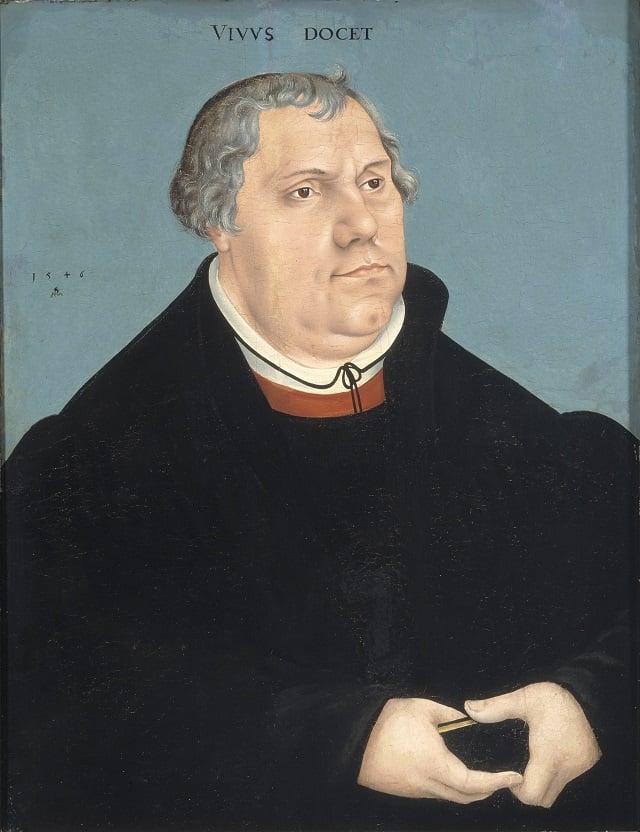
Photo credit: Portrait of Martin Luther (1546), by Lucas Cranach the Elder (1472-1553) [public domain / Wikimedia Commons]
Summary: Critique of the Lutheran & “Reformation” outlook, again mostly focusing on “faith alone” & soteriology, but moving on to a potpourri of “hot button” topics in the second half.












 Ad-Free & Subscriber Log-In