

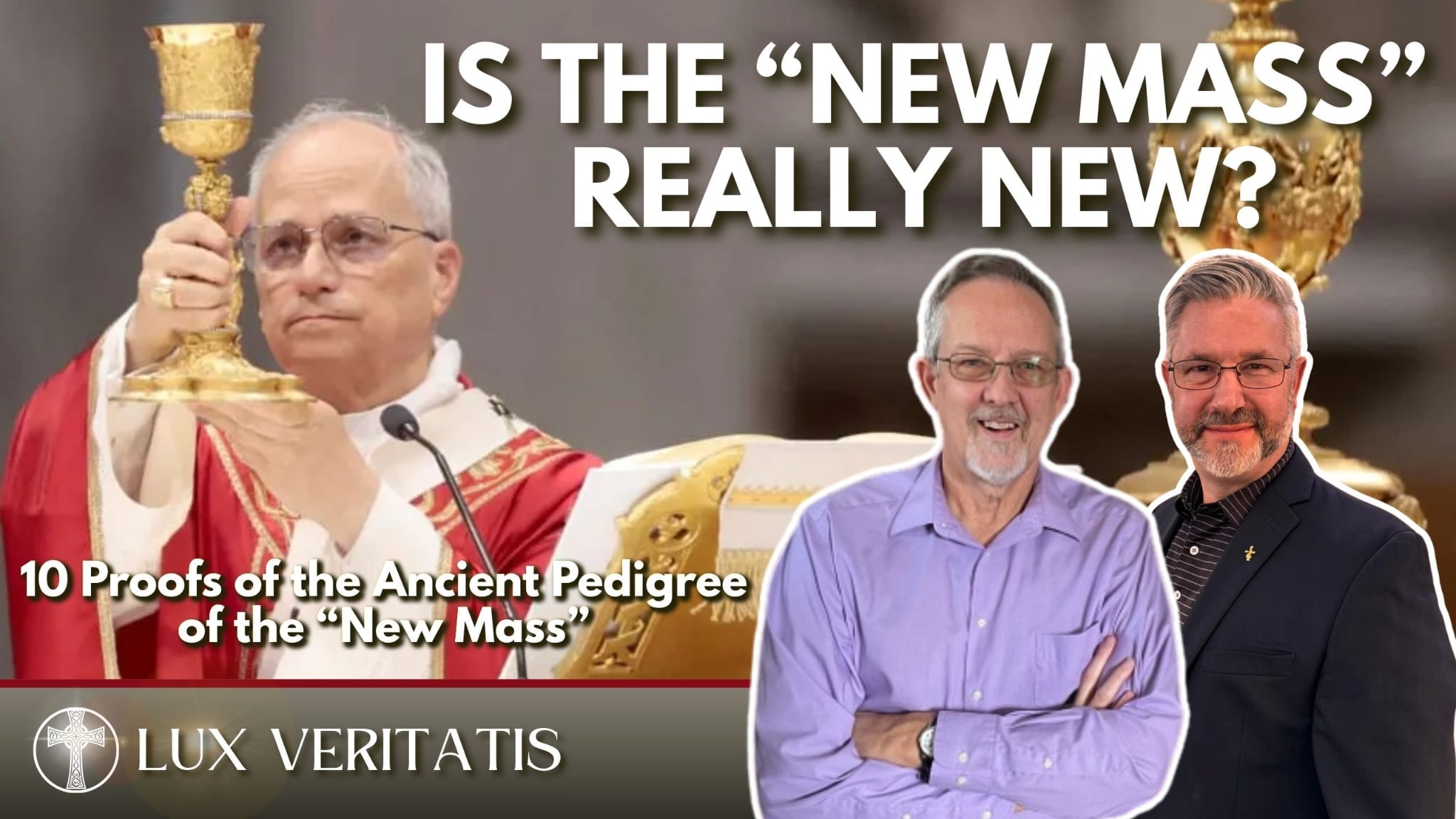
This is the initial transcript (minus the additional back-and-forth discussion) of the video, “Is the ‘NEW MASS’ really new? [10 Proofs of Ancient Pedigree]” (8-17-25), published at Lux Veritatis, with production and artwork by Kenny Burchard.
*****
What is known as the “New Mass” is more properly called the “Pauline Mass”: since it was introduced during the papacy of Pope St. Paul VI and is the Mass usually celebrated in Catholic Churches in the Latin or western rites. It followed the Tridentine or “Old” Mass, often known as “TLM.” The Pauline Mass is thoroughly grounded in historical Catholic liturgy. It’s neither an innovation nor a novelty, if one means by those words, “totally new” or “utterly disconnected from what came before.” And it often hearkens back to very old practices. I will highlight ten factors in support of this claim.
1) Much More Bible
One person calculated that the Missal of Pope St. John XXIII (1962): routinely used for the TLM today, utilized in its readings, 22% of the Gospels, 11% of the rest of the New Testament, and 1% of the Old Testament. By contrast, the Pauline Mass, not counting the readings of the Psalms, uses 14% of the Old Testament, 90% of the Gospels, and 55% of the rest of the New Testament, for a grand total of about 72% of the entire New Testament. Bible readings and teachings were prominently featured in the Mass of the early Church.
2) General Intercessions
The TLM doesn’t include this. If one accepts the reasonable premise that prayer is a good thing, then this is a worthy and welcome aspect of the Pauline Mass. The entry on “Liturgy” from the Catholic Encyclopedia of 1913, noted that in the early Church, “We hear very soon of litanies of intercession said by one person to each clause of which the people answer with some short formula.”
3) “Bringing Up of the Gifts” or the “Offertory Procession”
This is also absent in the TLM. It encourages participation of the laity, which is a good thing, provided that proper reverence is encouraged by the priest. The article, “Offertory” in the old Catholic Encyclopedia, asserted that “Originally . . . the people brought up bread and wine which were received by the deacons and placed by them on the altar.” This ceased only after the ninth century.
4) Reciting the Entire “Our Father” (or, “Lord’s Prayer”)
Only the ending portion is recited in the TLM. If we say something, we tend to pay more attention to what is being said. The prayer was first taught by Jesus in the Sermon on the Mount, which was addressed to the common people. The tense throughout is “us”, so it’s sensible for the congregation to pray it together. The article on “Liturgy” from the Catholic Encyclopedia stated that “We find too very early that certain general themes are constant. . . . It could not have been long before the archetype of all Christian prayer — the Our Father — was said publicly in the Liturgy.”
5) Holy Communion in Both Forms
This is not practiced in the TLM. Although this was justified historically, biblically (the Last Supper) and theologically, in due course it wasn’t practiced because of hygienic factors, ease of distribution, and the biblical and theological belief that the entire Christ is present in either of the consecrated elements. Justin Martyr, writing around 155 in his First Apology (chapter 65) recorded that “each of those present . . . partake of the bread and wine mixed with water.”
6) Holy Communion Received in the Hand, Standing
Philip Schaff, the famous Protestant Church historian, writing about the period from 100-325 in the second volume of his History of the Church, section 68: “Celebration of the Eucharist” notes:
The elements were placed in the hands (not in the mouth) of each communicant by the clergy who were present, . . . with the words: “The body of Christ;” “The blood of Christ, the cup of life;” to each of which the recipient responded “Amen.” The whole congregation thus received the elements, standing in the act.
In the TLM, the consecrated host only is received, kneeling and in the mouth, without saying “amen.” That’s four differences from the ancient ceremony, whereas the Pauline Mass perfectly reflects it. Schaff noted that kneeling during communion only became general after the twelfth century. The Catholic Encyclopedia in its article, “Genuflexion”, asserted, “That, in the early Church, the faithful stood when receiving into their hands the consecrated particle can hardly be questioned.”
7) Eucharistic Prayer and Consecration Spoken Out Loud
In the TLM they are read silently by the priest. This fosters more awareness and attention and active participation of the congregation as to what is happening and mirrors the practice of the early Church. Up until the seventh century in the west, these prayers were read aloud. The practice of silently reading them seems to have begun in France, for reasons that are not clear.
8) Eucharistic Ministers Administering Holy Communion
Anglican historian of the liturgy, Gregory Dix, in his classic volume, The Shape of the Liturgy (London: Dacre Press, second edition, 1945) observed,
At all events the deacons retained a special connection with the administration of the chalice, even at Rome, and also the right to administer the reserved sacrament under the species of Bread, which is assigned to them by Justin. (99. 135-136)
9) Female Eucharistic Ministers
Fr. Brian Harrison notes that this was sometimes allowed in special circumstances, even in the early centuries:
From ancient times, in convents of cloistered nuns situated far off in the desert where priests and deacons seldom visited, the Church allowed the Mother Superior to take the Eucharistic Body of Christ from the tabernacle in order to give Holy Communion to the other sisters; however she was not allowed to make use of the altar in doing so.
This . . . was also reflected in the wording of the 1917 Code of Canon Law. Canon 813, §2, of the old Code . . . stated: “A woman may not be a minister of the Mass, except when no male is available and for a just cause” . . . (“ ‘Altar Girls: Feminist Ideology and the Roman Liturgy,” Living Tradition, No. 88, July 2000)
10) Altar Table Separated from the Tabernacle
The critique of this is that it draws attention away from Jesus in the Tabernacle and the sacrificial essence of the Mass. But this was the case in ancient Christian practice. The Tabernacle over the altar was a relatively recent practice, as the Catholic Encyclopedia article, “Tabernacle” verifies:
In the Middle Ages there was no uniform custom in regard to the place where the Blessed Sacrament was kept. The Fourth Lateran Council and many provincial and diocesan synods held in the Middle Ages require only that the Host be kept in a secure, well-fastened receptacle. . . . From the sixteenth century it became gradually, although slowly, more customary to preserve the Blessed Sacrament in a receptacle that rose above the altar table.
Related Article
“New” / Ordinary Form / Pauline Mass: a Traditional Defense (with Massive Historical Documentation, + Summary of Vatican II on Liturgical Reform) [6-18-08]
Related Book
Mass Movements: Radical Catholic Reactionaries, the New Mass, and Ecumenism (Dec. 2012, 205 pages)
Related Website
Eucharist, Sacrifice of the Mass, & Liturgical Issues





 Ad-Free & Subscriber Log-In