Looking a little closer at Pagan Leaders, Clergy, and Teachers

"La Lecture," by Auguste Renoir

An online academic journal called Hybrid Pedagogy posted a piece that I wrote about a student’s perspective on pedagogy, which for those (like me) who aren’t teachers by trade, is the method and practice of teaching. There is a discussion happening in academic circles about the changing roles of teacher and student. The “brick and mortar” classroom is being supplemented, and sometimes replaced by online learning environments, and social media tools, like Twitter, are becoming discussed as possible teaching tools.

This discussion may not seem relevant to anyone outside of the academy, but I think it warrants some attention from the Pagan Community, a.k.a. the Pagan/Polytheist/Recon/Eclectic/Many-named people. There might be a parallel worth exploring.

We had a discussion about the difference between what we want from Pagan leaders and what we need from Pagan leaders a few months back. These questions continue to be relevant as we consider how to include our voices in interfaith dialogue, as was suggested we do in a recent Wild Hunt post, or as we ponder with Drew Jacob (a “non-Pagan”) how Paganism might grow into a world religion.

I’d like to open up this conversation again by asking: Should Pagan leaders serve, among other things, as teachers within the community?

DruidMeb voiced something to this effect in her response to “What do we want from our Pagan leaders?“:

“I expect our leaders to not only be polymaths but to also to be compassionate pastoral counselors and gifted teachers. However, in the Neopagan community, we are often inundated with a plethora of self-declared leaders, many of whom do not possess the requisite characteristics to lead well. The failure of these individuals to effectively direct and prepare their members may often lead to burnout, drama, and Witch wars.

The ethical thing to do, if you wish to be a leader, is to develop the skills and knowledge necessary to provide a welcoming and safe spiritual home for your members. If you are lacking in a particular area, you must be mature enough to recognize it, compensate for it or balance it out somehow, and attempt to rectify your shortcomings by educating yourself. If a leader is unwilling to look at their own work critically and evaluate their own efforts, then they are no one I’d want to follow.”

If Pagan leaders or clergy are to serve the Community (big “C”), or their individual community (their grove, their circle, their local Meetup group, etc.), as teachers, should they be involving themselves in conversations about pedagogy outside of the Pagan Community? Teaching comes quite naturally to some, but there are still techniques and skills that are worth exploring in a more formal academic environment. Perhaps those considering a life of service or leadership within their Pagan tradition have cause to pursue this kind of education.

Kate Dennis, a spiritual director and interfaith minister, explains her role as a leader in a slightly different way on “What do we NEED from Pagan leaders“:

“As Pagan clergy I don’t so much see myself as a leader as a resource. My  knowledge and experience is something for others to draw from so they can enrich their own experience of spirituality worship. In the larger context, I am only one of many resources and not an absolute.”

Leader, teacher, clergy — I’m not sure that there is even widespread agreement about the definition of these terms among Pagans, and this may be a good starting point for dialogue.

How do you define these three roles/positions? Do you see there being a connection between a Pagan leader and a Pagan teacher? How about “clergy” — does that word sit well with you?

If you’re a part of a Pagan tradition that trains people to lead or teach, what informs your pedagogy?

Feel free to teach me what you know by posting a comment in the thread below, or engage with a fellow reader about her ideas. And be sure to visit the Hybrid Pedagogy piece to get more context about this discussion on pedagogy.

You Say Tomato, I Say Druid.

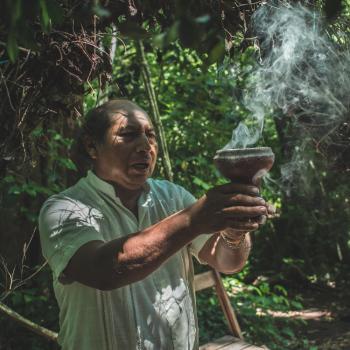
First image that came up when I googled, "Druid."

Ever since I took the name, Teo Bishop, and made it my own — both in a religious sense and through the proper legal channels — I’ve had cause to explain what it is that I do on this blog. My writing, as well as my deepening engagement with my own spiritual work, are both major influences on my decision to undergo this transition.

Identity is interesting, and something that often goes undiscussed. What we are, how we identify, is often more experienced than it is questioned. That is, this seems to be true for many people I know.

Then there are people like me, my queer compatriots, and my Pagan brethren who appear to always be in a rich, complicated, and often conflict-laden dialogue about what it means to be us; always debating which words are right to use, and which are out-of-bounds. In fact, it was my little inquiry into identity with publicly not-Pagan, totally world-adventurer, Drew Jacob, back in May of last year which led to his firestorm-post, Why I’m Not Pagan, and my followup piece, Pagan is the New Gay. The whole back-and-forth put my lil’Druid blog on the map.

When I started writing Bishop In The Grove, my intention was to have this blog be a place for me to document my studies through a training program offered through the American Druid fellowship, Ár nDraiocht Féin (ADF). This was going to be my Dedicant Journal, a series of writings that charted my progress on the Dedicant Path. But, it wasn’t long before my focus shifted, and questions of identity began to surface.

How was I to reconcile the Christianity of my youth with this burgeoning practice of polytheistic Druidry? What, exactly, did it mean to be a “Druid?” How could I avoid falling into the trap of allowing this new religious expression to become a kind of role-play? How was I to remain authentic, both to myself and to my community? (Dig through the Post Archive and you’ll find evidence of all of this….and more.)

The conclusion I’ve reached, which is still very much an idea to be examined, is that my spiritual and religious life is intended to be more of a dialogue than a single state of being. Any religious moniker I take, be it Christian (as it was for two decades), Druid, Neopagan, or Pagan, it is most important to me that this title is representative of an ecosystem of practice as well as serving as an introduction to a discussion on belief. The latter may not be paramount, but it is important to me. Practice also means more than how I approach my home shrine; it also extends to the way I navigate my internal world, the world of ideas and emotions, and which methods and approaches I use to engage with my thoughts and inquiries.

Druid, then, is not simply a title which connects me to ancient Celts, or to other Indo-European peoples; it is a word that is representative of a very modern, very immediate, and very personal religious expression which is influenced by a variety of modern, and possibly ancient religious technologies, some Irish, others American, and some completely unique to me; and at the same time, the word points to a practice of deliberate and persistent inquiry, introspection, and contemplation.

This resonates with me personally, and so this is how I intend to use the term.

But would you say that I have, what a friend recently called, “a Druid’s perspective?”

In an interfaith setting, where individuals are often called to speak as ambassadors for their religious or spiritual traditions, how does my definition hold up? Patheos is an interfaith blogging website, and my blog is the lone Druid’s Grove on their servers, but what I’m talking about is real, person-to-person, interfaith work.

How does the description I’ve offered of Druid resonate with you? Does it make sense? If you use the word to describe yourself, does it feel accurate to your experience? If you reject the word altogether, could you explain why?

Second, could you imagine a situation in which a modern Druid is acting as a representative for the wider community of Druids within an interfaith setting? How would you feel about there being an “Ambassador of Druidry” to other faith traditions?

WAKE UP, PAGANS! The End is Here!

I think “eschatology” is a funny word. Speaking it out loud makes potty-jokes come to mind. Say it, and I remember being 5.

The definition of eschatology, “the part of theology concerned with death, judgment, and the final destiny of the soul and of humankind,” is much less funny. It, one might say, is a party pooper.

(Too easy.)

Seriously though, when thinking about the End of the World it doesn’t hurt to throw in a dose of humor. Severity has its place, but I don’t think it belongs in every place.

If you’ve been a regular reader of this blog, you know that I’m not afraid of making things heavy. I’ve been upfront and honest about my own spiritual journey, asking questions about relevance and confessing doubts about community. This has been a space where I’ve encouraged dialogue, and practiced, as best I could, a kind of even-mindedness. It’s a practice, and it isn’t always easy.

Author, Michael York, writes in his guest post on The Wild Hunt that we are on “the brink of catastrophe.” He’s not altogether wrong. Pay attention to the science (or follow Archdruid Greer’s well-written blog) and you will agree that if there was ever a time where action was necessary, it is now. And for those of us who see our G/gods as being intrinsically connected to the land, you’d think we would be at the forefront of the movement for ecological awareness or preservation.

York’s post stirred up a great number of responses, many of which were quick to point out that the post sounded like “fear mongering.” They, too, are not altogether wrong. But fear is not completely out-of-place in this discussion, either. Drought is scary. So is the thought of a lack of nutrient-rich topsoil (a real, and growing problem). The ecological crisis, when it comes down to it, is no laughing matter.

But fear does little to inspire.

Frame the crisis as evidence of the End Days or the End of the World, or chose to look at one man’s decision to step out of leadership as evidence of the Beginning of the End of the Pagan Community, and you miss out on an opportunity to encourage dialogue, or contemplative introspection. From where I stand, it would be better to draw the focus back to our own motivations, our own choices, and encourage us to ask ourselves how we think we arrived at this point.

York says that,

We are disappointingly unimaginative as a communal voice despite some exemplary individuals among us.

I say, that kind of language doesn’t help. If anything, this is an example of a missed opportunity to be imaginative.

Leadership need not be relegated to the few, or to the charismatic, or to the “exemplary individuals.” Leaders need to be self-aware, self-empowered, and considerate to the needs of their people, their land, and the planet. If this is true, then the task at hand is not to chastise one another for our ignorance or lack of imagination, or to point out how we have failed; but rather to help cultivate our own self-awareness, to find new ways to inspire and empower each other, and to spend time in contemplation so that we might better understand which of these “needs” require our attention first.

So, ignore the title of this post. The End is Not Near, nor is it really an end. We are in a process.

The questions to ask yourself are, “How can I become more engaged in this process? How can I exercise my will to affect what is happening around me? How are my individual choices connected to the health of the various ecosystems which I inhabit? Begin with the questions. Sit with them, and then observe what comes up.

Should it start to get too heavy, say the word “eschatology” out loud, and giggle like a preschooler.